Get the latest food, drinks and things to do news directly to your inbox. Subscribe Now
A six-foot tree of hostage tags is going up at the Museum of Jewish Heritage

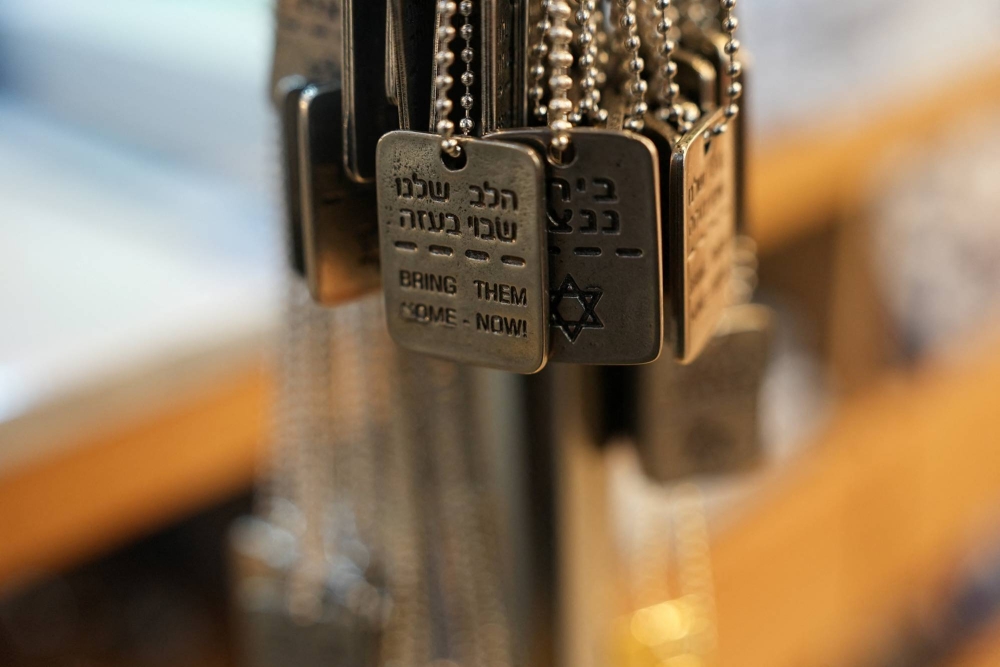
For about two and a half years, a certain kind of New York Jew could be spotted at fifty paces by the ball chain around the neck. The tag at the end said Bring Them Home Now or carried a name or just a date. Einat Admony told us in early 2025 that she and her kids had worn theirs since that October, and so had a fair portion of Jews around the world.
Then, on January 26, the remains of Ran Gvili, the last hostage held in Gaza, came home. The clock in Tel Aviv’s Hostages Square stopped at 843 days, and the tags became a question of etiquette. You don’t throw one out but you don’t quite keep wearing it either, most probably went deep inside bedroom drawers.
Starting Wednesday, the Museum of Jewish Heritage, at 36 Battery Place, has a place for them to be in. “Rooted: A Testament to Jewish Resilience” is an acrylic tree trunk standing a little over six feet, with thousands of those metal tags and pins sealed inside, contributed by New Yorkers and Jews elsewhere who had evidently also been staring into their drawers. It’s by Dede Bandaid and Nitzan Mintz, the Tel Aviv street artists who spent October 9, 2023, pasting the first Kidnapped posters onto Manhattan lampposts. Those went out as free downloads in 22 languages and became, that fall, some of the most photographed and most torn-down paper in the city.
A trunk is a sensible form for the job. It’s the part of a tree that keeps a record without being asked. Acrylic, on the other hand, is a more pointed choice, since it is also what vitrines are made of. The tags were never precious, they cost a few dollars apiece but encasing them turns them into museum objects, which is a polite way of saying it turns them into the past. We suspect that is the work’s actual argument, perhaps.
The continuity is what makes the piece worth the trip downtown: Mintz said at the time that the posters were deliberately not memorials. They assumed the people pictured were alive and asked to be read that way. A tag was the same proposition, worn on the body. “Rooted” is what happens once the proposition is settled, for better and very much for worse, and the objects have to become something that can stand in a room.
The installation is curated by Shlomi Rabi of Bridgewell Arts and co-presented with UJA-Federation of New York and the Hostages and Missing Families Forum. It’s up through October 25, after which it moves to UJA’s offices.